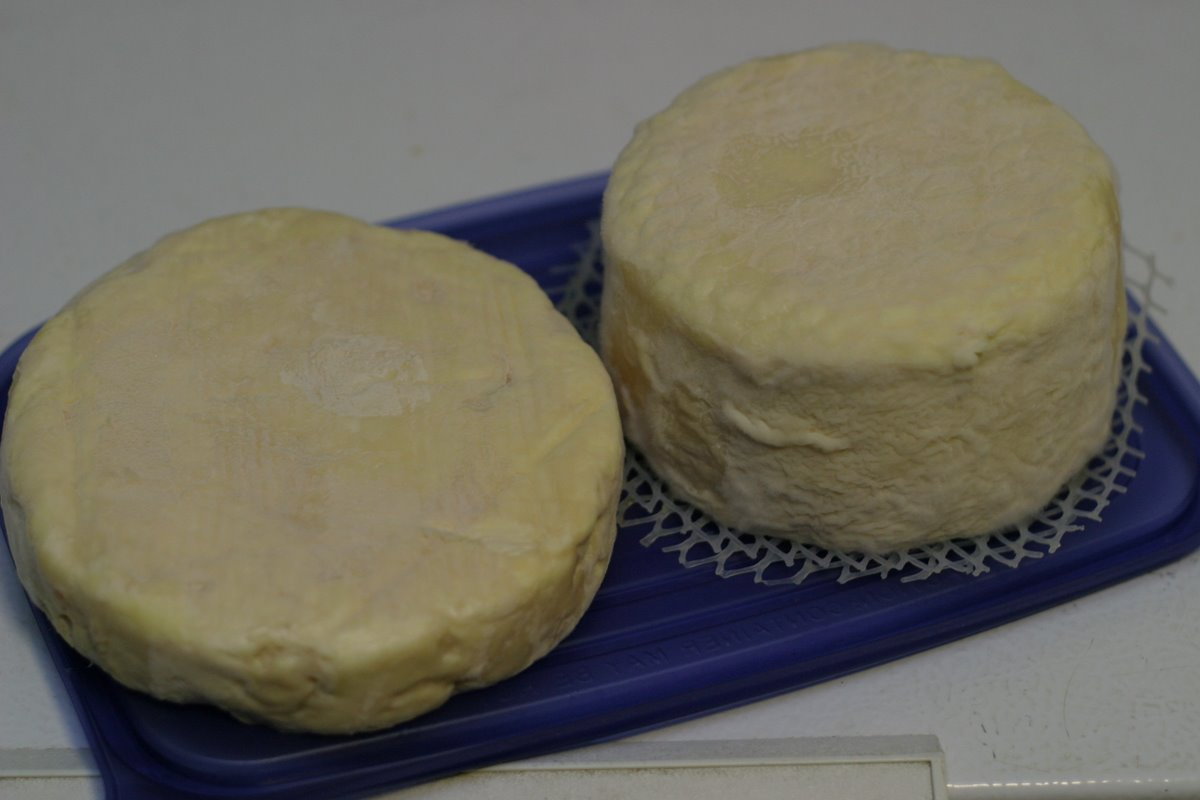
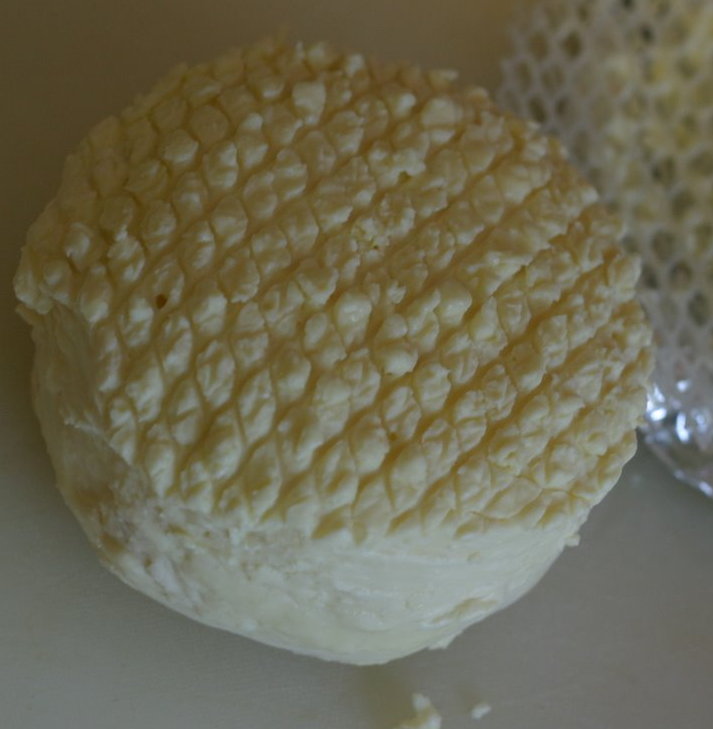
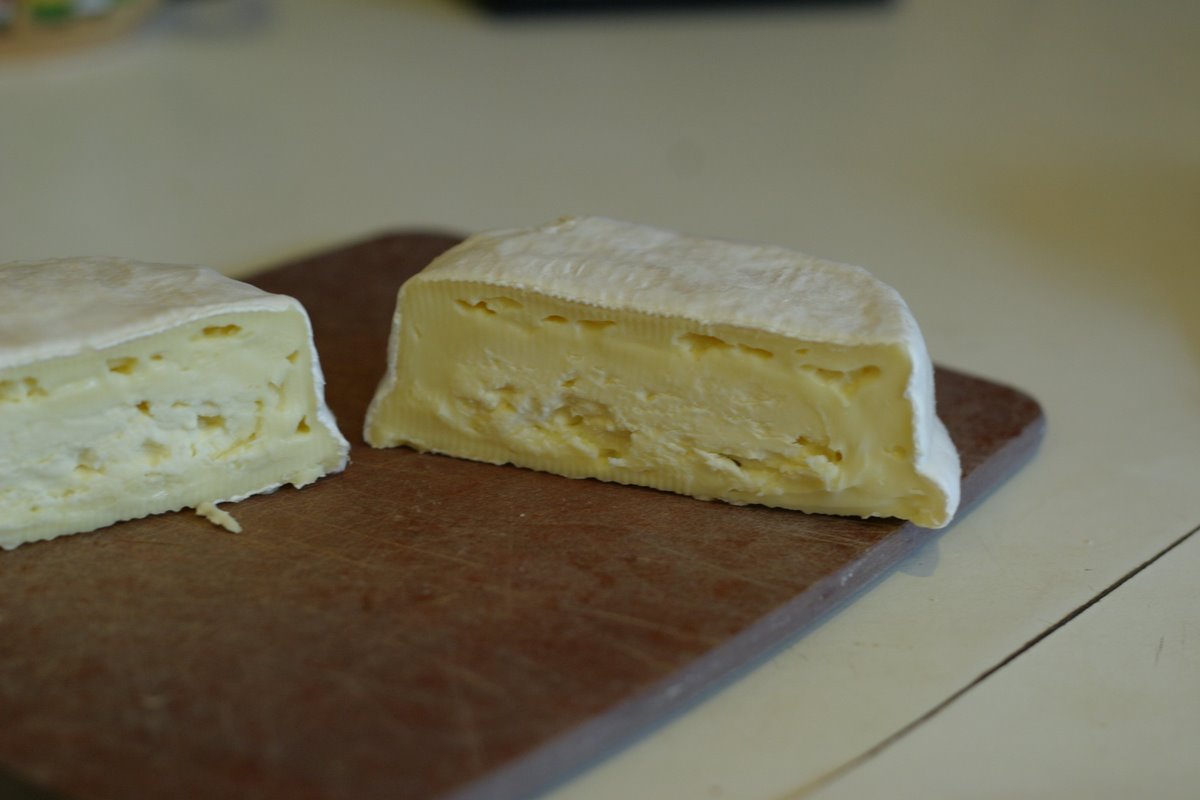
I really like washed rind cheeses. So for our first podcast, Jeff Cowan and I followed a recipe for Muenster cheese which had us include b.linens along with the starter culture. A week later, I learned while taking the class at OSU (see previous post) that b.linens need oxygen to thrive and it is better to be applied to the outside of the cheese along with a 10% salt solution during the washing phase (I also learned that washed rind cheeses are one of the harder cheeses to get right). So when I returned from the class I drenched my Meunster cheeses with a 10% brine innoculated with b.linens. I left the surface dripping wet, which I fear may have been one of my many mistakes.
After 4 weeks I had a surface that was very slimy, with a strong Limburger smell.
There was no characteristic orange growth except for one spot on the smaller of the two cheeses.
I posted in cheeseforum.org a request for advice and a little feedback, the best of which came from user francois who stated that I did not have b.linens growing, but instead a strong yeast infection. According to him, the smell I thought was coming from b.linen growth was coming from protein breakdown due to the yeast.
I tried scraping off the layer of slime and re-washing with a brine solution.
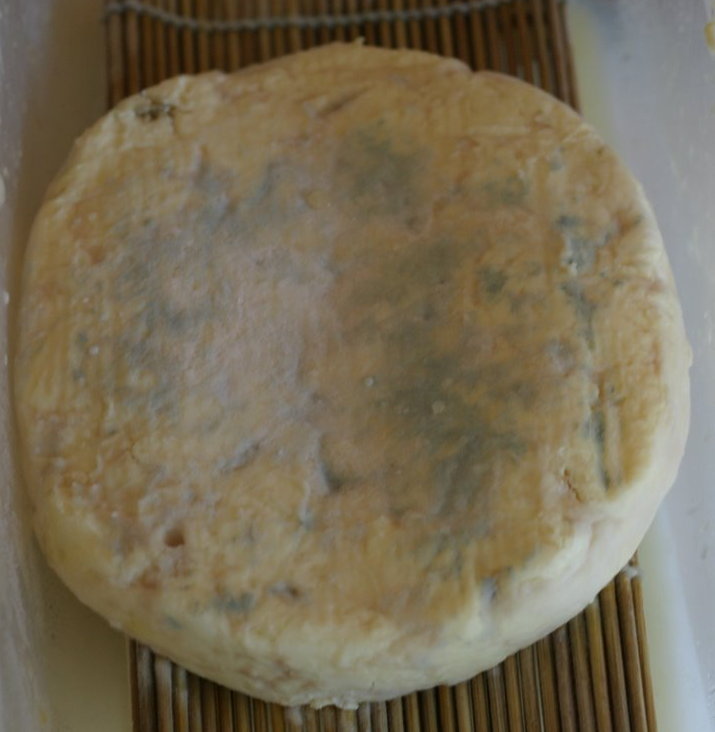
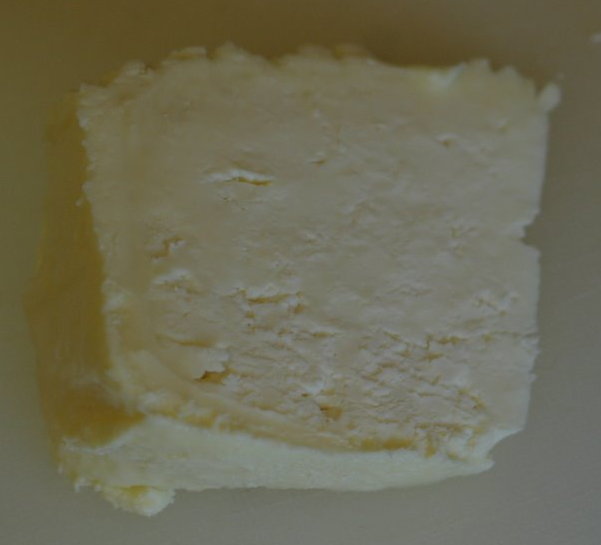
I went on vacation for a week, and when I returned I found a very smelly, slimy mess of a cheese. The smaller cheese had grown some blue mold and the larger was slimy again. Slicing into the larger cheese revealed a firmer paste and more horrible smell. I braced myself and tasted it. Extremely strong and unpleasant ammonia flavors forced me put my open mouth under the kitchen faucet to try to rinse foul substance out of my mouth. This was a home cheesemaking attempt gone horribly wrong.
I will attempt this again in a couple of months, and try to avoid the pitfalls I encountered this time around.
On the encouraging side, the Camemberts I brought home from the OSU class (rescued from going to waste) have turned out fantastic. They seem to need a bit more salt for my taste, but they are runny and have the right flavor. Now I need to give a lot of them away, as they probably only have a couple of weeks of perfect ripeness in them.
I first became obsessed with cheesemaking when my wife surprised me with a cheesemaking class at Kookoolan Farms in April of 2009 (that is me in the black aloha shirt in the background of some of the pictures taken by Jill Waterbury on that page). We watched as Mary Rosenblum went through the first steps of her gouda recipe in class (we did not finish pressing or brine the cheese in class).
A few weeks ago I opened my first gouda, which was my third cheese, after 3 months of aging. Since I was gathering footage for my entry in the Travel Oregon "Oregon's Bounty" competition, I has my brother-in-law film the opening for potential footage in my entry. The editing process was cruel, and a lot footage could not be squeezed into the 2 minutes allowed, including this footage. However, it makes a perfect subject for a post, so here is the video:
I was disappointed with the cheese. It turned out sour, to my taste, and not really enjoyable. It had the aroma of sour milk. My family kept saying it was good, but I have to disagree. I think they may have just been being polite.
The gouda was made with Organic Family homogenized, pasteurized milk bought from Fred Meyers. Mary Rosenblum did say that it was probably worth making your first few batches with less expensive store bought homogenized milk, so you get your cheesemaking skills sharpened before buying expensive raw milk for your hobby. In retrospect, I think it is worth jumping into raw milk as early as you feel comfortable with it. You spend so many hours in the cheesemaking process, you might as well invest the money to buy good milk so you have something you are proud of when you are done.
In the second half of the video, I open my first Camembert, made with raw milk purchased from a farm in Redland, Oregon. This cheese turned out much better, except that it was way too salty. I attribute this to the fact I used pickling salt instead of cheese salt to salt the camenbert. The recipe I used called for rolling the fresh wheels of camenbert in a plate of salt. I think that if I had used cheese salt, or kosher salt much less salt would have ended up sticking on the cheese. The cheese has a wonderful camembert/brie flavor, but the salt is overpowering. I consider it a mild success, and a lesson learned for next time.